

Proof of Work Vs Proof of Stake: What’s the Difference?
Get Breaking News First!
Editor’s choice
-

🔐 One Wallet for Everything Is How Most Traders Get Hurt. Here Is How Many You Actually Need
-

💰 Don’t Sell Your Bitcoin – Borrow Against It: The Best Platforms in 2026
-

MetaMask Who? The Web3 Wallets Traders Are Actually Using in 2026
-

💼 When Crypto Trading Becomes a Business: The IRS Rules Every Active Trader Needs to Know
-

₿ Why Local Businesses Are Taking Bitcoin Seriously in 2026
-

⚡ The Best of Both Worlds: How Hybrid Crypto Exchanges Are Changing the Way We Trade
Everyone talks about price action, meme coins, and moonshots—but no one’s asking how the whole thing actually runs under the hood. That’s where consensus mechanisms come in.
They’re the invisible rulebooks that make sure your crypto doesn’t magically duplicate itself or vanish into a rogue fork. And in Web3, two main systems keep the chaos in check: Proof of Work and Proof of Stake.
So what’s the difference? Why are they constantly compared? And more importantly—should you actually care?
Join our community of 400K+ and never miss breaking news!
We respect and protect your privacy. By subscribing your info will be subject to our privacy policy . Unsubscribe easily at any time
Spoiler: yes, you should. Let’s break it down.
🚀 Proof of Work (PoW): The Original Powerhouse

While crypto might look like magic internet money to the untrained eye, it’s actually built on some pretty slick tech. And at the heart of it all is Proof of Work (PoW)—the original consensus mechanism that kicked off the whole decentralized revolution.
PoW is basically a global math-off where miners compete to solve cryptographic puzzles. The first one to crack it earns the right to add a new block and grab the reward.
Fun fact: PoW wasn’t even invented for crypto. It was born in the ‘90s as a spam prevention tool, and didn’t find its true purpose until Bitcoin turned it into digital gold in 2009.
Here’s how it works: your transaction joins a crowd of others in a block, and miners enter a cryptographic showdown to solve a complex puzzle that seals the deal.
Whoever solves it first gets to broadcast the winning answer to the network and—cha-ching 🤑—snags the reward. Right now, that’s 3.125 BTC per block, plus any transaction fees. Not bad for some serious number crunching.
Talking about Bitcoin, these countries are taking a strategic Bitcoin reserve very seriously.
⚡Proof of Stake (PoS): The Energy-Efficient Alternative

After watching Proof of Work burn through enough electricity to power small countries, crypto needed a glow-up, and that’s where Proof of Stake strutted in.
No more math Olympics. With PoS, you just lock up your crypto as collateral, and boom, you’re a validator. No mining rigs, no power plants, no fan noise that sounds like a rocket launch.
First rolled out by Peercoin in 2012, PoS has since gone mainstream. Networks like Tezos, Polkadot, and Solana all run on it, letting coin holders validate transactions and secure the network.
It’s faster, greener, and easier on your wallet. Heck, it runs on hardware not much beefier than your regular laptop 🙌.
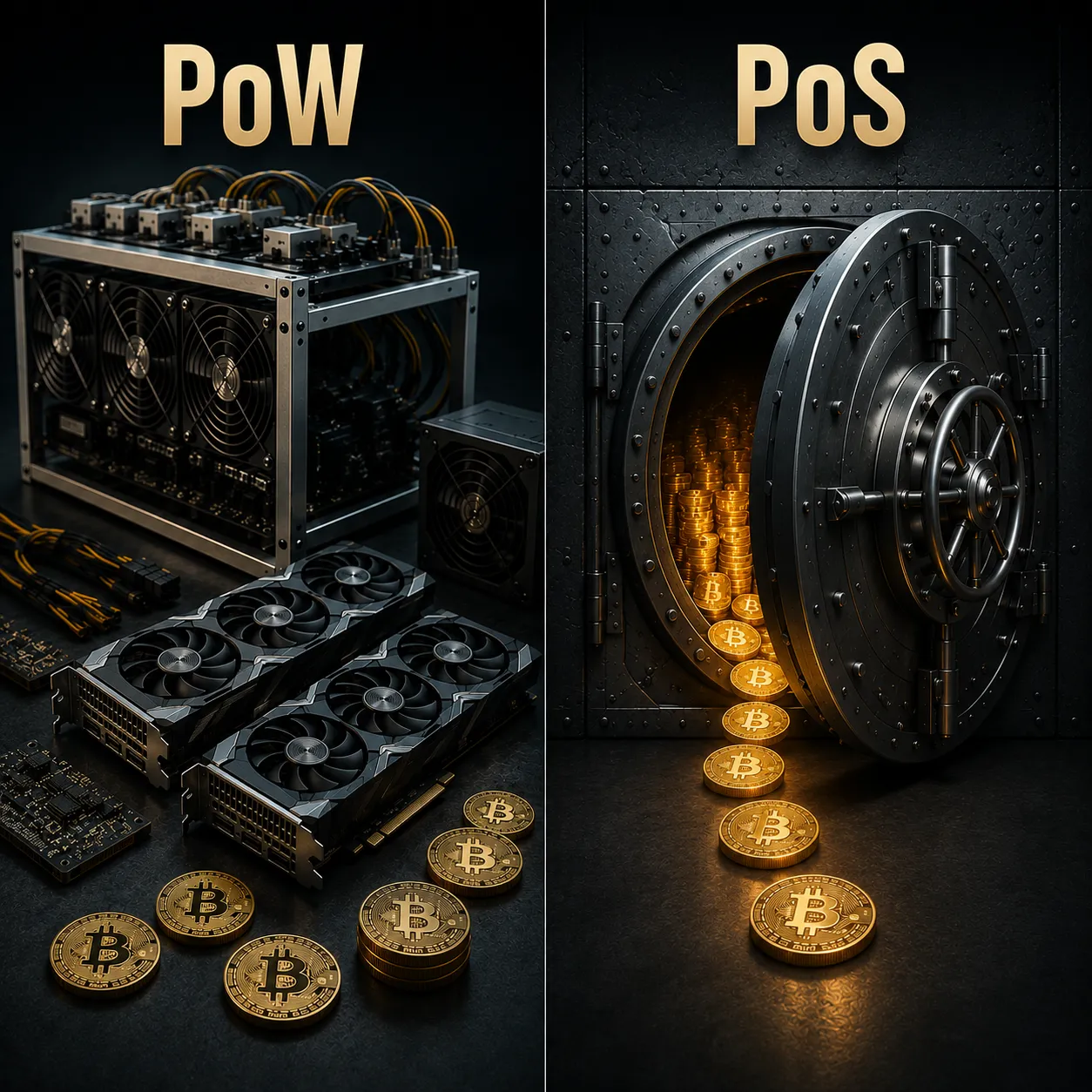
🥊 Head-to-Head: Proof of Work vs. Proof of Stake
🔋 Energy Consumption

The staggering energy consumption difference between Proof of Work and Proof of Stake might just make your jaw drop – we’re talking about the difference between running a small country and charging your phone😄!
Join our community of 400K+ and never miss breaking news!
We respect and protect your privacy. By subscribing your info will be subject to our privacy policy . Unsubscribe easily at any time
Bitcoin’s PoW system gobbles up more electricity than Finland and Argentina combined, consuming a whopping 91-150 TWh ($5.5 billion) annually. Wattt?! (pun-intended😂)
Meanwhile, PoS is the eco-friendly cousin who carpools – it uses less than 1% of PoW’s energy.
Think of PoW as a gas-guzzling monster truck, while PoS is more like an electric scooter.
The good news, though. is that over 50% of Bitcoin mining is now powered by renewable energy.
🔐 Security Method

Proof of Work’s security is built on raw, digital muscle whose security guarantee is the sheer effort and resources needed to get involved.
To hijack a PoW system, you’d need to amass more computing power than the entire rest of the network combined. That’s like trying to empty the ocean using a bucket😂.
Proof of Stake isn’t about flexing computational biceps, it’s about putting your money where your mouth is. Validators lock up their crypto as collateral, and that stake is their reputation on the line.
Mess with the system, approve shady transactions, or try anything slick? Say goodbye to your staked funds. It’s like putting down a massive deposit that gets torched if you act like a bad actor. Less mining, more skin in the game.
To launch a 51% attack on a PoS system, you’d need to acquire a majority stake – meaning you’d have to become the crypto whale of all crypto whales, making it incredibly expensive and risky to even attempt.
So, PoW relies on making attacks computationally infeasible, while PoS makes them economically suicidal.
🧨 Decentralization

Proof of Work’s physical requirement helps spread control across many players, making it tough for any single entity to dominate the network. Mining pools allow smaller participants to combine their resources and still compete effectively in the network.
Proof of Stake flips the script: power flows to whoever stakes the most coins. The more you lock up, the more say you get. Great for efficiency, but it raises some uncomfortable questions, like whether PoS is quietly turning into a digital oligarchy where the rich get richer and run the show.😒.
⛔ Accessibility/Barriers to Entry

PoW demands some serious hardware muscle and a ton of electricity. Those mining rigs aren’t exactly cheap, and they’ll keep demanding upgrades faster than a teenager demands a new iPhone😂!
PoS, on the other hand, is more like buying a seat at the table. While you’ll need to stake a significant amount of crypto upfront, you can validate transactions on a standard laptop – no need for a personal power plant in your basement😆! For Ethereum specifically, validators must have 32 ETH staked to participate.
Both systems have their financial barriers, but PoS opens the door wider for participation, letting you validate from pretty much anywhere with a decent internet connection.
🏎️ Speed/Scalability

While PoW grinds slowly solving complex puzzles (taking precious minutes or even hours), PoS zips through transactions with the efficiency of a well-oiled machine😎.
You’ll notice this difference especially during peak times – PoW networks can get as congested as a rush-hour highway, while PoS keeps traffic flowing smoothly.
🔖 Conclusion
At the end of the day, it’s not about picking a winner. Proof of Work and Proof of Stake take wildly different routes to the same destination: secure, decentralized networks. 🛡️⚙️
PoW flexes raw computational muscle; PoS plays the long game with capital and incentives. One’s built for battle-hardened resilience, the other for eco-friendly scalability. Which one’s better? That depends on what you’re building—and what trade-offs you’re willing to make.
Now that you know the foundation of most cryptocurrencies, here’s how to find the most profitable ones to invest in today💰.
Connect with over 20,000+ traders and investors in our Telegram community for genuine insights, free from hype. Stay updated with our newsletter for the latest news.