

Can Crypto Work Without the Internet? Here’s What Actually Happens
Get Breaking News First!
Editor’s choice
-

🔐 One Wallet for Everything Is How Most Traders Get Hurt. Here Is How Many You Actually Need
-

💰 Don’t Sell Your Bitcoin – Borrow Against It: The Best Platforms in 2026
-
MetaMask Who? The Web3 Wallets Traders Are Actually Using in 2026
-

💼 When Crypto Trading Becomes a Business: The IRS Rules Every Active Trader Needs to Know
-
₿ Why Local Businesses Are Taking Bitcoin Seriously in 2026
-

⚡ The Best of Both Worlds: How Hybrid Crypto Exchanges Are Changing the Way We Trade
If the internet went down tomorrow… would your crypto still exist?
Short answer: yes. But not in the way most people expect.
Crypto runs on the internet, but it’s not as dependent on it as it seems. Take away Wi-Fi, mobile data, even entire networks, and the system doesn’t just disappear, it adapts.
Because at its core, crypto isn’t tied to apps or exchanges. It’s tied to a network that can be accessed in more ways than most traders realize.
Join our community of 400K+ and never miss breaking news!
We respect and protect your privacy. By subscribing your info will be subject to our privacy policy . Unsubscribe easily at any time
From satellites to radio signals, there are already ways to keep Bitcoin running without traditional internet.
And this isn’t theory, here’s how it happens.
💡Why Crypto Seems Net-Dependent
At its core, crypto depends on connectivity. Nodes need to stay in sync, constantly sharing data to keep the network running. That’s the whole point of a distributed system; thousands of computers around the world updating in real time.
Cut that connection, and things don’t collapse instantly… but they do get messy, fast. Transactions slow down. Updates lag, and the network starts to lose its edge.
So the real question isn’t whether crypto needs the internet. It’s whether there are other ways to keep it running when that connection disappears.
📌 Offline Solutions
🗨️ SMS-Based

Something interesting happens when you strip crypto back to basics, it still finds a way to work.
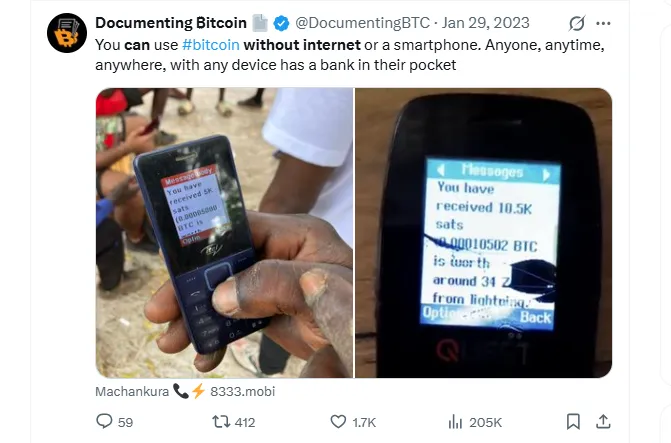
You don’t need fiber or 5G when even simple text messages can get the job done. Services like Machankura are already proving this across Africa, letting users send Bitcoin via SMS. No smartphone or data required.
It’s not perfect. You’re introducing intermediaries into what’s usually a peer-to-peer system, and transactions are slower.
But when the chips are down, slow bitcoin beats no bitcoin.
🛰️ Satellite-Based

Twenty-two thousand miles above your head, satellites are quietly becoming cryptocurrency’s backup plan. When your internet goes dark, these orbital guardians can still beam Bitcoin transactions down to Earth.
Join our community of 400K+ and never miss breaking news!
We respect and protect your privacy. By subscribing your info will be subject to our privacy policy . Unsubscribe easily at any time
When the internet goes dark, the network doesn’t stop, it reroutes. Instead of cables, data comes from space. Blockstream is already doing this, turning the sky into a broadcast layer for Bitcoin.
And with a small dish, a USB receiver, and a basic node setup, you can also receive blockchain data without internet.
So while everyone else is offline, your node stays in sync, verifying transactions as usual.
No subscriptions. No local network. Just a direct line to Bitcoin from orbit.
☢️ Radio-Powered

While satellites handle things from above, radio waves bring crypto closer to the ground.
Back in 2019, developers showed this was possible by broadcasting Bitcoin transactions over radio frequencies, turning basic radio setups into transmission tools.
The idea is simple: transaction data gets converted into radio signals, picked up by receivers, and passed along until it reaches the wider network.
It works, but it’s not exactly fast. You’ll need some specialized gear, and at some point, the transaction still needs to hit an internet-connected node to be confirmed.
Still, in situations where connectivity is limited, it’s another way the network finds a workaround.
🚨 Main Challenges of Using Offline Solutions

Offline crypto sounds cool in theory, but in practice, it comes with some real trade-offs.
The biggest challenges:
🔚 The Bottom Line
Crypto doesn’t stop when the internet does — it adapts.
And the traders who understand how the system really works are the ones who stay ahead when things get unpredictable.
Want insights like this before they hit the mainstream?
📩 Get breakdowns on market structure, hidden risks, and where crypto is actually heading from our weekly newsletter
Or tap into live setups and real-time updates:
🎯 Link up with 62k pros on Telegram for live alerts